Performance
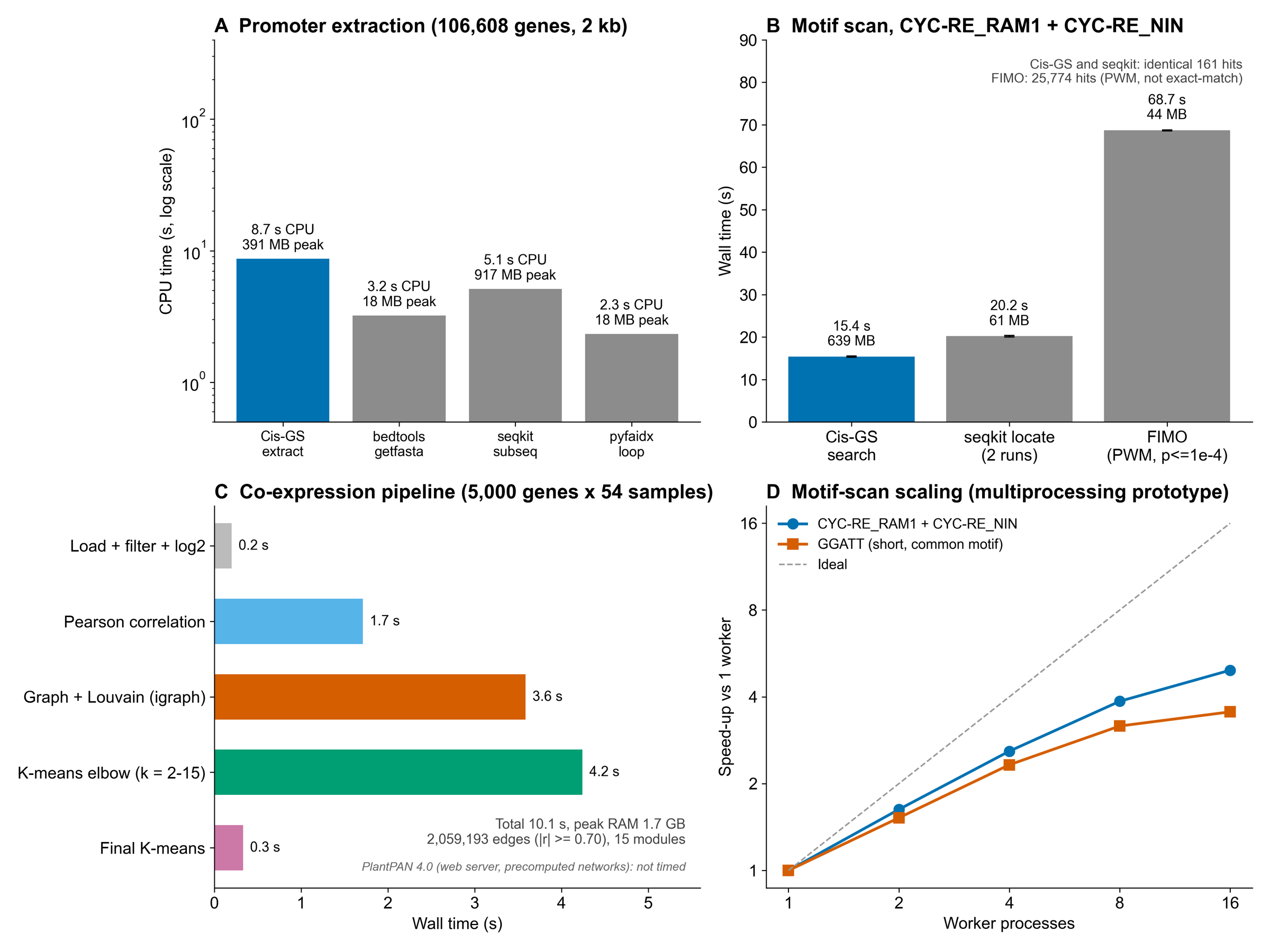
Cis-GS was benchmarked on the Arachis hypogaea Tifrunner genome (2.6 Gb, 106,608 annotated genes, 2 kb promoters) on one machine: Intel Core i5-14450HX (16 logical cores), 18 GB RAM, WSL2 Ubuntu. Every measurement is a fresh process, three repetitions, warm file cache; peak memory is the operating system’s maximum resident set size. Reference tools: bedtools 2.31.1, seqkit 2.14.0, samtools 1.24, pyfaidx 0.9.0.4, MEME Suite 5.5.9.
Resources per step
Step |
Tool |
Wall time |
Peak RAM |
Note |
|---|---|---|---|---|
Promoter extraction |
Cis-GS 1.3.2.4 |
4.9 s |
0.39 GB |
includes GFF3 parse; 20.8 s on a cold first read |
bedtools getfasta |
1.8 s CPU |
18 MB |
plus 1.4 s BED, one-off |
|
seqkit subseq |
3.7 s CPU |
0.92 GB |
||
pyfaidx loop |
0.9 s CPU |
18 MB |
||
Motif scan (2 motifs, incl. significance) |
Cis-GS |
15.4 s |
0.64 GB |
161 hits |
seqkit locate -d (2 runs) |
20.2 s |
61 MB |
161 hits (identical) |
|
FIMO, p <= 1e-4 |
68.7 s |
44 MB |
25,774 PWM hits (different question) |
|
Short motif stress test (GGATT) |
Cis-GS |
13.0 s |
1.18 GB |
442,811 hit rows |
Co-expression pipeline (5,000 genes x 54 samples) |
Cis-GS |
10.1 s |
1.67 GB |
2.06 M edges, 15 modules |
Notes
Extraction output is identical across Cis-GS, bedtools, seqkit and pyfaidx (same 106,608 sequences).
bedtools and pyfaidx remain faster at pure interval extraction; Cis-GS additionally parses the GFF3 and writes the promoter table used by later steps.
Cores: extraction and motif scanning run on one core. The co-expression step uses several cores inside NumPy / scikit-learn (about five on average). A multiprocessing prototype of the scan reached 4.9x at 16 workers; it is not part of the release.
Memory: every step stayed under 2 GB, so the workflow runs on an 8 GB laptop.
FIMO is listed for timing only: it scores position weight matrices and accepts mismatches, whereas Cis-GS matches IUPAC consensus patterns.